The dance of power · September 2026
Who surrenders first
Domination and submission — two skills nobody teaches us
Let me take you under a volcano.
Late afternoon, an estate at the foot of Mount Etna, the mountain smoking up there as if it were minding its own business. Inside: rugs on the floor, a smell of wood and flowers, bare feet. I'm standing in the middle of the room, and behind me there's a girl holding a rope.
In a moment I'm going to let her decide where my body goes.
And here's the detail you need: I've had everything under control for six days. The sound of every single thing that makes a sound, my own concert, the thousand things that have to add up, my face. Six days of me deciding. And now I'm about to hand a stranger the one thing I've never handed to anyone.
I'm telling you this scene not to show off, and not to confess some peculiarity either. I'm telling you because in those minutes I watched, live, the dynamic that governs every encounter of your life — the queue at the till, dinner with the family, a first date — and that nobody ever taught you to recognise.
When was the last time you let someone else have the control —
not because you were tired,
but because you chose it?
But let's take it in order.
I've just come back from the Kama Etna Festival: six days at the foot of the volcano, a hundred and fifty people trying to take off a bit of their armour.
I was there as an artist: I played a classical guitar concert, one of those where at some point the room stops breathing and it's just you, the strings and the sunset over the volcano. But I was also responsible for the sound, and I was part of the organisation. A lot of responsibility, and a lot of control to hold.
And in the middle of all that, I was taking the workshops.
Until one morning I woke up with a hunger I hadn't seen coming: the hunger to stop deciding anything at all. To let go of control, even for an hour.
You can have everything under control.
But not forever.
Nobody holds it forever.
The pact spoken first
Back to that room. In one of the festival's workshops we were learning to tie. Hemp ropes, knots, a body that hands itself over and a body that holds it.
I let a girl tie me. And before she touched the first rope I said the sentence that is the key to this whole article: “Don't expect me to tie you afterwards.”
I know how it sounds. But it's the opposite of what it seems. In that moment I had nothing to give back, and saying it first was the only way not to cheat her. No exchange, no debt hidden under the table. I wanted to let go. Full stop.
She accepted knowing. And it's only because she knew that I could really let go.
A negotiated surrender isn't a surrender.
It's an investment.
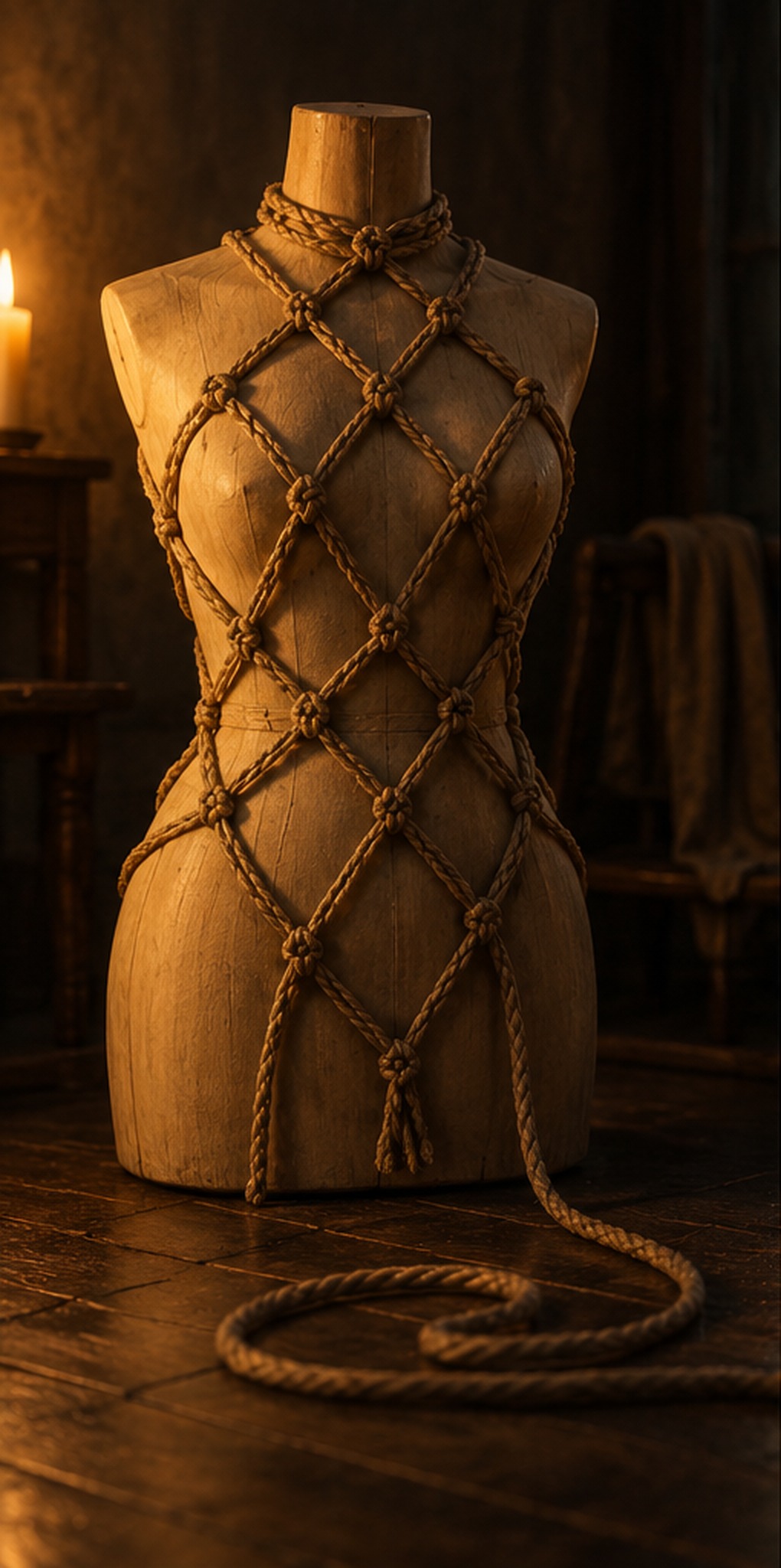
What happened inside those ropes I'm not going to tell you. I'll give you only the finding: the instant I stopped deciding where my body was, I felt how much strength I burn every day on something I thought was free.
Keeping everything under control costs effort. And you only notice when you stop.
The dogs
The year before, same place, I'd done a very simple exercise. You walk around the room. When you cross someone you both stop and look at each other, and right there it's decided: either one of you submits to the other — and the dynamic begins — or nothing happens, and you keep walking until you find someone to give the control to, or someone to take it from.
Like dogs meeting for the first time. They sniff, they circle, and in three seconds — without a growl — it's already settled who lowers their head. Nobody has spoken. And yet the pact is there.
And here comes the part that ruined my innocence: we do it too. You walk into a bar, someone introduces you, you pass a stranger in the street. Who speaks first. Who looks away. Who picks the table. Who laughs at the other one's joke.
Every encounter opens with a question
nobody says out loud:
who has the control, now?

The arm that gives way
This year the workshop was led by a different facilitator, and the form was even barer. That's exactly why it worked better.
You take hold of each other's arms. One pushes, the other resists. You stay there until the one resisting decides to give way. Then you swap.
I did it with a girl I liked a lot, which made the exercise considerably less theoretical. She started, so the first to surrender was me. Then I took it, and she let herself go. Two things, in ten minutes.
The first: surrender doesn't come from exhaustion, it comes from a decision. There's a precise instant when you could still resist and you choose not to. That instant is yours. It's no accident that to surrender comes from reddere, to give back: you're not losing something, you're giving back something you were gripping without knowing why.
The second: both sides are frightening. Giving way exposes you. But taking it makes you responsible — you have to know how hard to push and when to stop. It isn't free power. It's weight.
Giving way isn't losing.
It's choosing the instant you stop pushing.
The morning after
The next day I woke up full of energy. I ran into the girl who had tied me and, before I said anything, she confessed something of her own: she'd been left wanting me to be the one taking control this time, and her to let go all the way.
We looked for an empty room. We said beforehand what would happen and what wouldn't. Then I took the control.
And it was the most beautiful thing of the whole week — not for me, for what I saw happen to her. At a certain point she let go of control for real, and her face lit up. It's not a figure of speech: it was a different face. It looked like I'd taken a hundred kilos off her.
That's when I understood I wasn't taking anything. I was holding. Whoever takes the control, if they do it well, doesn't own the other person: they carry a weight the other is finally allowed to put down for a few minutes.
I didn't take her freedom.
I took the weight of control off her.

Then I came home
And the uncomfortable part began: once you've seen this thing, you can't stop seeing it.
I saw it at the table, with family. I'm telling something that matters to me and someone interrupts to say the meat needs salt: in three seconds the room has changed owner and my story ended there. I saw it in the person who talks without leaving a gap, while you wait for a space that never comes. I saw it in a child throwing a tantrum at the exact moment two adults were about to say something important — because right then he's the one in charge, and he knows it perfectly well. And I saw it in the person who's always late and keeps you waiting.
None of them is a bad person, and hardly any of them notices. That's the point: domination is subtle. But once you've seen it, you see it everywhere.
And that's where the whole difference lies. At the festival there was an agreement, and there was an end. At home there isn't. So the push and the resistance stay there for years, and turn into the tone of voice, the silence at the table, the look that makes you finish your sentence halfway.
In a workshop the power dynamic lasts twenty minutes.
In a family it lasts thirty years,
and nobody has ever called it by its name.
The frame
The gesture is always the same. What changes is what surrounds it.
At the festival there was a word that could stop everything, at any moment: stop. And two more for the in-between degrees — orange to slow down, red to pause. Anyone could say them, at any instant, and they were respected immediately: no arguing, no explaining yourself, no looking like the one who ruins the game.
Outside, that word doesn't exist. Nobody gives it to you and nobody teaches it to you. The dynamic starts without ever being declared and there's nothing to stop it — which is why everyday life is far more insidious than a room with ropes.
The only thing to do is make the word yourself. “Wait, let me finish.” “Not now.” “That's enough.” Small, awkward words that almost nobody uses. But with them you can push without breaking anything. Without them, whoever takes control becomes a bully and whoever lets it go disappears.
Without agreement it's coercion.
With agreement it's medicine.
The gesture is the same.
Why this is sexual intelligence
Because that's where the current is born.
Go back to the arm exercise. One pushes, the other gives way: in that moment there's a difference of potential between the two, like between the poles of a battery, and the energy flows. You don't have to take my word for it: just look at people's faces while they do it. They light up.
Now remove the difference. Two who push equally wear each other out: these are the couples who play for power every single day, over everything — who's right, who decides where you're going, who has done more for the other — and go to bed exhausted every night without either one giving an inch.
Two who yield equally, on the other hand, don't move at all: these are the exceedingly polite relationships, where nobody ever takes control and nobody ever lets go. They fade out, and neither of them can say why.
It isn't love that's missing, in either case. It's the difference of potential.
And it's the same current that lights desire. You can love each other enormously, but if the two poles are identical, nothing happens in bed.
Then there's the part that concerns you. Taking control and letting it go are two muscles, and almost everyone trains only one. Whoever has only one isn't choosing anything: they do the same thing with everyone, always, for their whole life.
Whoever can't let go of control doesn't hold it.
They're held by it.
From tomorrow
You can start today, without ropes and without workshops.
Watch the first few seconds of your next three encounters: who speaks first, who looks away, who apologises without being at fault. Don't judge, watch. Noticing is already half the work.
Then ask yourself which of the two muscles you've never trained. Do you always keep control, even when you'd happily let it go? Or do you always give way, and call it peace that you've never decided anything? The answer won't please you, and that's fine.
And then try it, once. With someone you trust, agreeing beforehand: ten minutes I decide, ten minutes you decide. A walk with your eyes closed, the other person leading you. A dinner where only one of you chooses, from the table to the plate. What you do matters little. What matters is that you said it first.
And if there's an awkward sentence to say, say it first. Mine was “don't expect me to tie you afterwards”. Yours will take another shape: “don't expect me to call you”, “don't expect me to be fine afterwards”. Said first, it's a pact — the other person knows what they're accepting, and you can let go without feeling in debt. Kept for later, it becomes a bill to pay, and it's always the other person who pays it.
I came back from those six days with something school doesn't teach. We're not built to always keep control, and not to always give it away either. We're built to know how to do both, and to choose which, with whom, and for how long. It isn't character, it's a craft. And crafts are learned.
I started learning it at thirty-seven, at the foot of a volcano, with a rope around my wrists and a sentence said first.
Taking control is one skill.
Letting it go is the other.
Whoever has only one has neither.
Onward.
Where it comes from
This article comes out of the Kama Etna Festival 2026: six days at the foot of Mount Etna.
If these themes speak to you,
the book Sexual Intelligence — The Way of Fire explores them chapter by chapter.