The male cycle · 27 May 2026
The invisible cycle of man
Four weeks of seed retention — a map written from the territory
There's a man, inside me, that I only met when I stopped discharging. He had lived there all along, but to see him I had to do something our culture doesn't even consider: stop ejaculating. Not for a few days — for weeks. And in those weeks I discovered that my body is not the ever-identical machine I thought it was. It has a tide. It rises and falls, ignites and settles, moves through seasons. A slow cycle no one had ever named for me. This article is the map of that tide, drawn by walking inside it.
Let me say it straight away: this is not a collection of studies. It's what I saw by observing my own body. Precisely because I gave in so many times, I was able to see clearly what changes when I hold and what changes when I release. It's my personal map. Here and there it finds confirmation in some study or some ancient tradition, but it isn't born from there: it's born from what I lived. It isn't science, it isn't doctrine. It's my experience. Take it for what it is.
A word before we go in: even though it speaks of the male body, this is not an article for men only. It's for the man who wants to know his own tide, and it's for the woman who wants to understand the invisible cycle of the man beside her — and to rediscover, in the backlight, her own fire in its masculine form. Because, as we'll see by the end, both poles live inside each of us.
Because, according to the studies, man has no cycle. Testosterone rises in the morning and falls in the evening, in a twenty-four-hour turn called circadian. Woman, instead, has an infradian rhythm — twenty-eight days tied to the moon. Hence the line you hear repeated everywhere: "men are luckier, they don't have a cycle."
It's true. Until you stop ejaculating.
What retention is, and why science doesn't see it
For those who don't know what I'm talking about: seed retention is a man's choice to ejaculate as little as possible, conserving his jing — the vital essence which, according to Taoist medicine, is the first of man's three treasures: the jing (the essence), the qi (the vital energy that circulates and keeps us alive) and the shen (the spirit, the light of consciousness). The jing is the densest of the three, the closest to matter, and semen is its most concentrated deposit. To ejaculate it too often means emptying the reserve. It isn't an exotic belief: it's the foundation of five millennia of Taoist practice. All inner Taoist work, in the end, is one single thing: refining jing into qi, and qi into shen. Transforming matter into spirit.
And here I must clear up the biggest misunderstanding straight away — the one that makes people wrinkle their nose when they first hear of retention. Holding the seed does not mean giving up pleasure, nor stopping making love — with another person or with yourself. It means one thing only: not ejaculating. In our culture, ejaculation and orgasm have become the same word. They are not. Mantak Chia devoted his life to showing that a man can experience orgasm — the wave of pleasure that runs through the body — without losing the seed. The West has even forgotten this possibility exists: for us, orgasm is ejaculation, full stop. It's like having forgotten you can breathe with the belly, and not only by panting with the chest.
In my book Sexual Intelligence I devote an entire chapter to this theme — white gold and red gold, the two chemistries of the vital fire. There you'll find the full map. Here I want to do something different: tell you, week by week, what changes inside me when I decide to hold — because it's only in the direct trial that you truly understand what we're talking about.
There's a Taoist formula, handed down by Mantak Chia, for estimating how often a man should ejaculate in a healthy way: age × 0.2. I'm thirty-seven, so it works out to roughly every seven days. It isn't an iron rule — it's a rough compass, which with age tends to space out more and more.
Western science, instead, suggests ejaculating at least once a day to train the prostate. It's a half-truth. Training the prostate, yes. But also emptying every day the reserve of an essence that the body builds over much longer spans. Like most Western recommendations on sexuality, it's missing a large piece of the picture.
Western studies can't photograph the male cycle
because they measure a population that doesn't retain.
Let's take a simple example. Imagine a study on fasting done on people who, however, nibble something all day long: you'll never see the effects of fasting, because no one is actually fasting. With ejaculation, the same thing happens. In a society where people discharge constantly, the male cycle doesn't show up in the studies for a banal reason: almost no one goes through it. It isn't a gap in science, it's just that this knowledge lives elsewhere — in the body of the one who practises, not in the laboratories. Gurdjieff said it too: certain things you only know by making your own self the laboratory.
Week one — the runaway horse
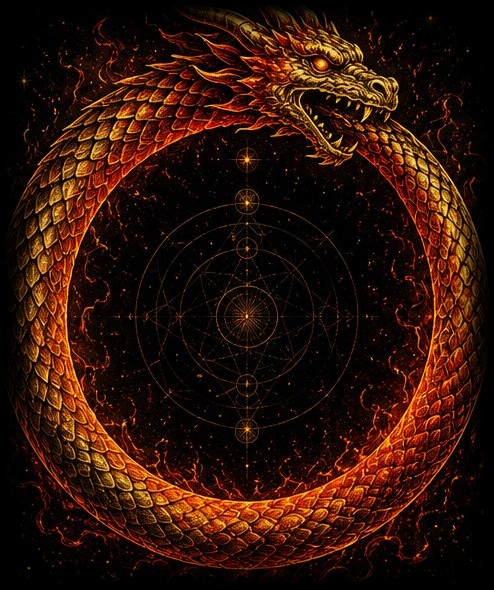
I'll start from the most common case: you're coming from a period of daily ejaculation, or nearly. The first week of retention is the fiercest. Carnal desire grows every day, until it settles at a level far above your normal.
What I observe in myself, in this phase, is uncomfortable to admit but honest: I tend to objectify the women around me as instruments of discharge. I don't decide it — I suffer it. It's the most animal movement my body knows. It's hard to keep the horses in check. They pull the carriage wildly, with no precise direction, and the coachman — the mind — struggles to take back control.
There are those who have tried to put numbers on this first week. The story goes that around the seventh day testosterone — the hormone of drive and male desire — has a spike upward, a flare that lasts a short while and then settles. The precise number matters little, and the study that gave rise to that legend was even retracted. But you feel the substance on your skin, you don't need a laboratory to recognise it: in those days something surges, strongly. It isn't a new stable state you've moved into. It's a wave that rises and that, if you let it pass, passes.
Important: this phase can deceive you. Many men begin retention, feel the fire rise violently, objectify everything that moves, get frightened of the animal they see in themselves, and go straight back to ejaculating. "Retention makes me worse," they say. No. Retention doesn't make you worse: it makes you more visible to yourself. It shows you what was already there, and that before you used to discharge away before it even became conscious. You're seeing your horse in the wild. It was there all along. You just kept it asleep.
Week two — the fire that rises
Toward the end of the first week something changes. Carnal desire begins to settle, then drops slightly. The libido lowers by a degree — not because you're switched off, but because the energy begins to rise. It rises toward the higher chakras, the Indian traditions would say. It rises toward the heart, the throat, the mind, the Taoists would say. Whatever you call it, it's the phase in which the objectification of the women around me begins to dissolve. And I begin to see their true beauty: not the one that ignites desire, but the one beyond the form of the body — the light, the grace, the whole world each woman carries within. It's a gaze I didn't have before — and it is, I only understand it now, my own feminine part beginning to see. They stop being the mirror of a need of mine and become living, whole people again, each with her own soul.
At the same time creativity re-emerges. The urge to play the guitar. The urge to train the body. The urge to write. Ideas become sharper. It's exactly what Napoleon Hill — the American author of Think and Grow Rich, one of the most-read success books of all time — already called, back in 1937, the transmutation of sexual energy into creative energy. He had studied many highly successful men, and noticed that almost all of them, instead of dispersing that charge, somehow channelled it into work and creation. The charge you don't discharge downward rises, and transforms. The same process that in Taoism is called the transformation of jing into shen — of essence into spirit.
But there's a price. The mood waves. In this phase I feel, within the same day, irritable and joyful, frightened and creative, restless and lit up. The fire amplifies everything. The gifts and the flaws. The creative capacity and the shadow. What was dormant inside me — the repressed anger, the ancient fears, the wounds — comes back to the surface together with the light. Not because retention makes you ill. Because retention reveals you.
Retention doesn't make you better or worse.
It makes you visible to yourself.
There's a physical reason behind all this too, and it can be said in simple words. Every ejaculation leaves a wake: for a couple of weeks the body stays a bit flatter, duller, less present — a kind of hangover that almost no one connects to orgasm, because they live inside it continuously. Those who discharge often never come out of that wake: as soon as they begin to rise again, they ejaculate once more and fall back to the bottom. That's why the second week of retention is a watershed. It's the moment you finally come out of the hangover from last time — and, by no longer ejaculating, you don't fall back into it. You stay up high. It isn't a theory I read somewhere: it's exactly in these days that I feel my body rise and stay there.
Week three — maximum creativity and the temptation to switch off
The third week is the most surprising. Sexual desire — the kind that is a discharge — has practically vanished. Sometimes there are small flare-ups, but they're easy to handle. The gaze on women, which in the second week had only just cleared, is now wholly serene: not even the charge remains, not even the mirror of need. They remain, and that's all. The body is quiet. The mind is clear. Creativity is at its peak.
And it's here that the difference between ejaculation and orgasm stops being a theory and becomes flesh. In these weeks the skin becomes hypersensitive: a single caress, a light touch, and small waves of pleasure run through the body — tiny orgasms that ask for nothing in return. At the same time, reaching ejaculation becomes almost difficult. The nervous system is calm, relaxed, and ejaculation needs the opposite: a peak, a sudden discharge. To provoke it I'd have to go looking for it — to imagine something graphic, to chase a strong stimulus. At rest, in the stillness, the body doesn't ask for it. That's where you understand, on your own skin and not from books, that orgasm and ejaculation are two different roads, and that you had always confused them.
This is the phase in which, in three days, you write pages you would normally have written in three weeks. It's the phase in which the guitar isn't practised out of duty — it's practised because the body asks for it. Ideas organise themselves. The world around you arranges itself as if it knew what you were doing.
But it's also the most dangerous phase. I say it from direct experience. If in this week you don't keep up the physical practice, the creative practice, and contact with nature, the accumulated fire overflows the banks. Not on the sexual side — there you're calm. It overflows into your relationships. You get irritated over nothing. You snap at the relative on the phone, at the friend who sees you too lucid and gets frightened, at whoever happens to be in range at the wrong moment.
And here comes the moment most recognisable to those who have practised. Sooner or later a friend, usually one you love, will look at you with that expression of affectionate concern and tell you "just discharge once and for all and stop doing weird things, do what everyone else does." I tell you from experience: it's almost a script, that's how predictable it is. And, from their point of view, they even have a reason. But inside that sentence hides a truth worth looking at.
Whoever advises you to discharge
is advising you to hide.
What the friend rejects in you is not the practice of retention. It's your true self beginning to radiate. Exactly as you, until shortly before, rejected it and kept it locked in the cellar. It's the law of the mirror from chapter seven of the book. When someone around you begins to shine, and you're not ready to shine too, the mirror becomes unbearable. The easy solution is to switch off the mirror. "Discharge, do as we do." Translated: switch off, so I can stay comfortable in my own switched-off state.
Don't resent those friends. They're the level you were at too, until yesterday. But from that week on, begin to recognise the movement — theirs and yours — and learn not to put out the fire just to avoid unsettling those beside you.
Week four — the body that asks to let go
Toward the end of the third week, or into the fourth, something changes again. Vitality begins to drop. Not abruptly — slowly. You feel more restless. More unmotivated. The fire that until yesterday rose clear now grows heavy. The body, in an unspoken way, asks to let go.
It's exactly what a woman lives in the last week before menstruation. There appears what we call premenstrual syndrome. Irritability, skin-deep sensitivity, fatigue, self-criticism: a drop that turns into mood. Well, the man who holds for a long time knows something very similar too — a dull nervousness, a slight melancholy, the strings taut for no reason. Those who have observed male animals at the end of mating season have described the same state, and there are even those who call it the "irritable male syndrome." But the name matters less than the thing: it's the masculine side of the same passage. The body that, after holding for a long time, begins to ask to let go.
In this phase the body says: it's time. Exactly as a woman's body says: it's time for the blood. The moment has come to empty the old to open to the new. A month of accumulated charge asks for a way out.
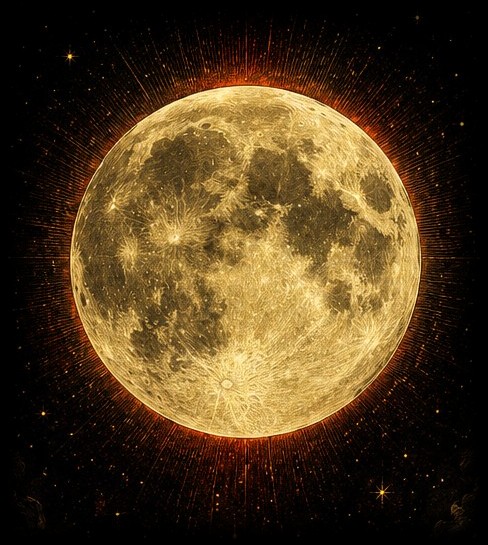
Many traditions place the release ideally at the full moon — not because the energy drops in those days, but because it's at its peak. The full moon is the moment when the vital charge is highest: the body is full, lit, at the height of its tide. To release then means handing over the seed from the crest of the wave, not from its emptying — an act of fullness, chosen, not a surrender to fatigue. No school fully agrees on the date, and each must learn to feel their own. But the deep principle, whatever the day, is one alone: the release is conscious, chosen, rare, ritual. Not mechanical, not reactive, not automatic.
Release as a rite, not as relief
One thing I notice, talking with conscious women, is that menstrual blood is in the middle of a cultural revolution. More and more women are returning to consider it sacred — as it was in many ancient traditions before monotheism declared it impure. People speak of conscious menstruation. Blood is collected in cups. The cycle is recognised as an initiation that repeats twelve times a year.
Here is my provocation, for the men reading. White gold deserves the same respect as red gold. For millennia our culture has treated semen as a fluid to be discharged every time the body asked for it, like mucus to be expelled. The consequence is that we have completely lost the art of conscious release. To ejaculate has become an automatism, exactly as for pre-revolution women the blood was something to hide and not to look at.
To ritualise the release means a simple thing: not to ejaculate for mechanical discharge. To ejaculate because the body asks for it and the moment has come. To ejaculate with consciousness, with presence, ideally in an act of love — with a real person, or with yourself if that is your moment, but with awareness. I don't discharge. I release. They are two different gestures, even if the physical action is the same.
And there's a difference you only feel once you've lived it: there's making love, and there's discharging dense emotions through sex. In the first there is no goal, no need to arrive anywhere, nothing to discharge, no need to shout. It's a celebration of life, made of continuous orgasms and moans, elegant, never histrionic. In the second there is hunger, the rush, the density — wild and slightly unconscious sex that chases the discharge like a need to be put out. And beneath that hunger, almost always, there is something else: the need for intensity in order not to feel the void we carry, deep down, inside us. The higher the discharge, the less you feel that void — for an instant. Then it returns, and asks again.
Careful: I'm not saying density is wrong. Sometimes, after having known the other, you feel like diving into it, entering that energy in play and by choice — and that's perfectly fine. The point is another. I, and almost everyone around me, don't end up in that density by choice: we end up there through distraction, through an inability to steer our own biological machine. And it's a different thing to choose to light that fire than to simply be swept away by it without noticing.
Discharge is mechanical. Release is conscious.
Discharge empties you. Release completes you.
When the act ends
There's a question that, at this point, arises naturally, and it touches the other person too: if the man doesn't ejaculate, when does the act end? For our culture the answer is obvious — it ends with ejaculation. It's the ejaculation that lowers the curtain, that says "there, it's done." Remove it, and suddenly no one knows where the end is anymore. It's something that throws both off balance, the man and the woman.
In the Tao the perspective is reversed. The man ejaculates when he wants to conceive a child. If instead he simply wants to make love, ejaculation isn't contemplated. It isn't a sacrifice, it isn't a deprivation: it's another way of being in the act, in which you don't race toward an end, but inhabit a present that doesn't need to close.
At first this throws everyone off. The woman — Western, but by now Eastern too, because today's culture has westernised everywhere — may feel she's at fault: if he doesn't finish, it means I'm not able to give him pleasure. And the man, for his part, may feel a sense of impotence, as if the work had been left unfinished, as if he had missed a duty. They are two cultural ghosts, not two truths. They are born from having placed ejaculation at the centre of everything, to the point of confusing it with the very meaning of the encounter.
A man who has learned to be multi-orgasmic knows yet another secret: he can raise and lower the erection almost on command, and precisely for that reason he stops chasing it. Because he has understood a simple thing — that the erection is not a test to be passed. It comes and goes like the breath.
The erection is only the body's yes
to life and to love.
And when you stop demanding it, you discover that you can make love even with a non-erect penis. The Tantric traditions have always known this: in the maithuna there's even talk of a vagina capable of receiving and drawing into itself a non-erect penis. These are paths that open only when you step out of haste and performance — paths that our culture, obsessed with the ending, doesn't even imagine.
And concretely? How do you let the erection go, in the end, without the shortcut of ejaculation? The traditions have their tools, and almost all of them work in the same direction: to take the energy — and with it the blood — away from the genitals and upward. Yoga calls it uddiyana bandha, the "abdominal lock": you empty the lungs completely and, with the lungs empty, you draw the belly inward and upward, beneath the ribs, as if sucking the navel toward the spine. It's a call upward. It's often accompanied by mula bandha, the contraction of the perineum; when the two unite — plus the closing of the throat — you enter what yoga calls maha mudra, the great lock.
The Taoists call the heart of this practice the orgasmic draw upward: with small contractions of the pelvic floor, the breath and the attention, you guide the lit charge up along the spine — what Mantak Chia describes as the microcosmic orbit. But the simplest principle of all remains the breath. Ejaculation needs a short, fast, panting breath — a crescendo. To make everything subside it's enough to do the opposite: long, slow breaths, deep into the belly. The nervous system relaxes, the wave withdraws, and the erection — which is only the body's yes, remember — dissolves on its own.
Said without mysticism: with these gestures you're simply moving the blood and the attention elsewhere, and letting the body return to calm. The ancient locks aren't magic — they're precise ways of telling the body "now we go down." The rest the body does by itself.
The warning that matters more than the article
Now something important. Perhaps the most important thing in the whole piece.
If you're thinking of trying retention, read this paragraph twice. Seed retention practised by someone who hasn't yet worked on their mental body and their emotional body is a dangerous practice. I don't say it to be dramatic. I say it because I've seen it, and in part I've lived it.
What I mean by mental body: the ability to stop a thought spinning in circles. The ability to see a limiting belief and replace it, at least in part, with a freer one. The ability to stay with your own thoughts without being dragged by them as by a river in flood. If you haven't built a minimum of these capacities, retention amplifies your obsessive thoughts until they become unbearable.
What I mean by emotional body: the ability to welcome and handle anger, fears, boredom, sadness, pain. Not to suppress them. Not to pour them onto others. To feel them, recognise them, let them pass through you. If you haven't built a minimum of these capacities, retention amplifies your emotions until you lose your mind. I tell you clearly. I've known men who, without these foundations, collapsed after a few weeks of retention, and mistook the collapse for a failure of the practice. It wasn't the practice. It was the practice done on ground that wasn't ready.
Fire without the brazier burns down the house.
Build the brazier first. Then light it.
That's why I myself have practised retention in stretches, without claiming to carry it on for continuous months. I gave priority to the work on the two bodies — mental and emotional — precisely because I've seen what happens to those who skip that part and go straight to the fire. When the two bodies are in order, retention becomes a sustainable practice, even a pleasant one. When they're not, it's petrol on a field of dry weeds.
The androgynous essence
I close where I began. Science says man has no cycle. My body says the opposite — and it shows the moment you stop discharging it.
The cycle of man and that of woman are not the same: they're like two mirror images. The woman rises toward the centre of her cycle — ovulation, the moment she is most magnetic — and then descends, down to menstruation. The man who holds walks the opposite path: he starts already charged, rises, and then slowly drops, down to the need to release. Two arcs moving in contrary directions. And yet the last part is identical for both: that irritable fatigue that comes before the release. There, man and woman truly resemble each other.
Hence the final delivery. Our essence is androgynous. All the great traditions say it, in a thousand different forms: the myth of the androgyne told by Plato, the wedding of masculine and feminine in alchemy, the Shiva and Shakti of India, the yin and yang of the Tao. Each of us has both poles within. The problem of modern culture is that it has made us forget them.
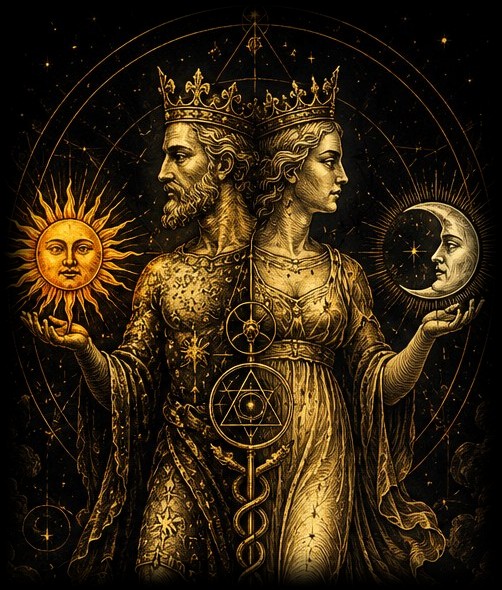
For a man, to practise retention is a way of observing his own cyclical feminine part. To rediscover the rhythm, the waiting, the passing through phases. To stop living as if we were continuous-discharge machines. To learn to contain.
For a woman, the mirror movement would be to observe her own penetrating, explosive, willed masculine part. To stop always living in waiting, in cyclicity, in receptivity. To learn to decide, to burst in, to emit without asking permission. It's the other half of the journey, mirror to this one. But the principle is the same: whoever knows only half of themselves knows zero of themselves.
White gold and red gold
are the same gold.
The book takes all this on in a deeper way, chapter after chapter. Here I've handed you the essential map of what happened to me when I began to hold. Take it, if it helps. Make it yours. But above all, remember that there is no virtue in holding for the sake of holding. The virtue is only in awakening to yourself. The seed is a means. The gold is within.
If you want to go deeper into these themes,
the book Sexual Intelligence — The Way of Fire takes them on chapter by chapter.